In this article4 sections
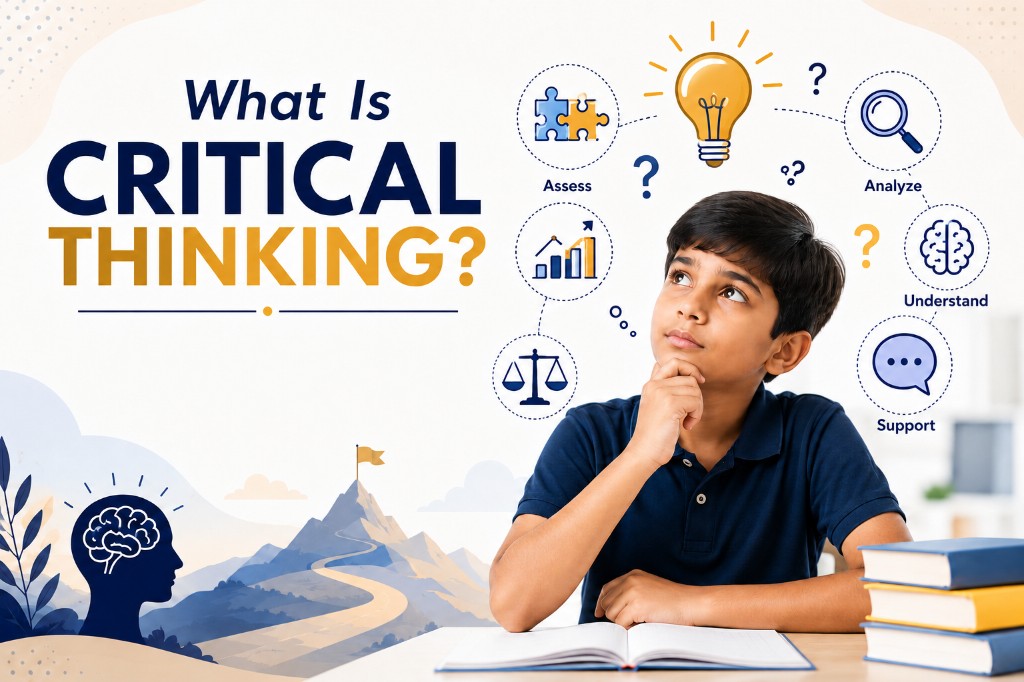
When children develop critical thinking, they learn to observe, question, compare, connect information, look for reasons and make thoughtful decisions instead of simply choosing the first answer that appears obvious.
What does thinking beyond the obvious mean?
Ask which object will sink in water. One child may recall a textbook answer. Another may ask what the object is made of, how heavy it is and whether its shape matters. One is recalling information; the other is using information to reason. Critical thinking begins when children ask “Why?” and “How?”
Five simple signs of critical thinking
- 1
Observe carefully
Notice details instead of rushing to an answer.
- 2
Ask questions
Want to understand why something happens.
- 3
Compare and connect
Identify similarities, differences, patterns and relationships.
- 4
Consider possibilities
Understand that the first answer is not always the only answer.
- 5
Explain thinking
Tell you why an answer was chosen, not just what it is.
How can parents encourage it?
- What do you think?
- Why do you think that?
- What else could happen?
- How can we find out?
- Can you think of another way?
The bigger picture
Critical thinking is a foundation for lifelong learning, not a separate subject for an examination. Brainiac Global builds early foundations; Epoch Olympiad explores conceptual understanding and application; MY CCBee helps schools track everyday learning so insight can lead to timely action.
“Don't just teach children what to think. Help them develop the habit of thinking.”
For schools
See what an Academic Health Report reveals about your cohort.
Register your school to receive dimension-level insights for every learner, benchmarked at school, national and international level.
Register your school