
Academic Health Report
Beyond Marks.
Understand How Your Child Thinks.
A single mark tells you where a learner finished. The Academic Health Report tells you how they got there — what they understand, how they reason, where they apply knowledge and what will help them next. One diagnostic framework, published in three age-tuned editions that grow with the learner.
3
Age-tuned report editions
19+
Cognitive & academic dimensions
3
Benchmark layers per dimension
1
Continuous learning story
One Framework, Three Editions
The report grows with the learner
The questions worth asking about a five-year-old are not the questions worth asking about a fifteen-year-old. Each edition keeps the same diagnostic spine and changes the lens, so a family can follow one continuous story from early play to advanced application.


Inside Every Edition
Eight things every report answers
However old the learner, the report is built to answer the same set of questions — and to answer them in a way that leads somewhere.
Learner context
School, teacher, assessment and date, so every insight is anchored to a specific moment in the learner's journey.
Dimension scores
Performance broken into the distinct abilities that build it, rather than collapsed into a single number.
Understanding vs recall
A deliberate split between what was remembered, what was understood and what could be applied.
Three-layer benchmarking
Each dimension read against school, national and international cohorts alongside the learner's own score.
Strengths named clearly
The abilities a learner can be confident about, stated in language a child and a parent both recognise.
Growth areas
Where the learner is still forming ability — framed as a stage of development, never as a failure.
What will help next
Specific, doable actions for home and classroom that respond to this learner's exact pattern.
A written insight
A short human summary that ties the data together into one paragraph a parent can act on.
From Assessment to Action
How a report is built
Assess
The learner sits an age-appropriate assessment built to reveal reasoning, not recall speed.
Analyse
Responses are decomposed into the distinct abilities behind them instead of one aggregate mark.
Benchmark
Each ability is placed against school, national and international cohorts of the same stage.
Act
The report closes with specific next steps for home and classroom, tuned to this learner's pattern.
Stage 1 — Early Years
Brainiac Global
Building Thinking Before Memorisation
No Percentile, No Comparison — A description of how a young child thinks
At this age a score would mislead more than it informs. So the early years edition never produces one. It reads six developmental lenses and reports each as strong or still developing, which is exactly how thinking behaves before formal schooling settles in.
The result is a report a parent can read in four minutes and act on the same evening: what the child already does well, what is still forming, and which everyday play would move it forward.
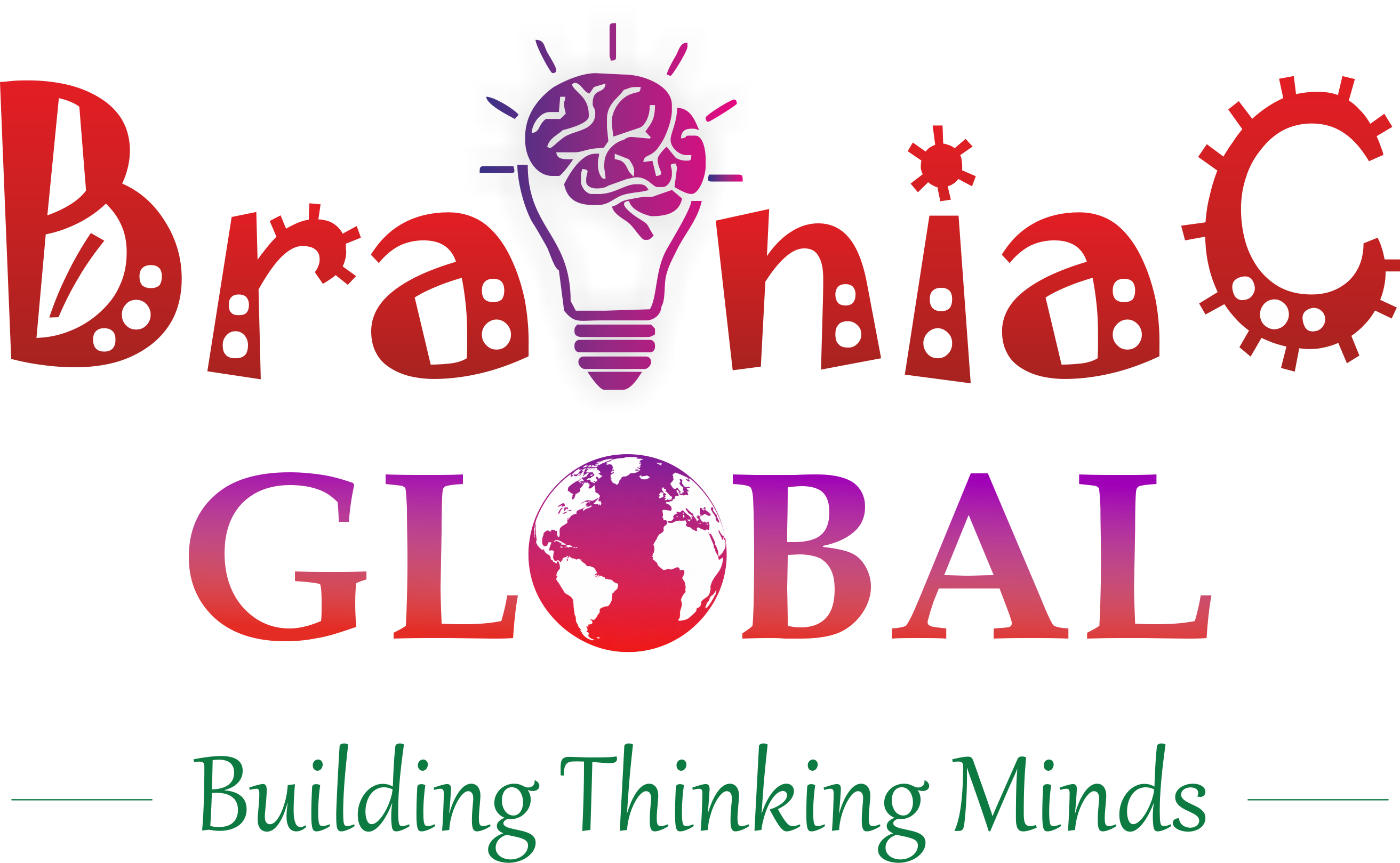
Academic Health Report
Building Thinking Before Memorisation
- Student Name :
- Kush Gupta
- School :
- Sunshine Kids World
- Class Teacher :
- Ms. Neha Verma
- Principal :
- Mrs. Neha Chabra
- Exam Name :
- International Brain Booster Olympiad
- Date :
- 17 November 2025
- Report ID :
- IBO25052
How your child is developing
Strengths to celebrate
- Notices small details easily
- Shows interest in puzzles and patterns
- Understands shapes and spatial positions
- Asks questions and loves to explore
Opportunities to develop
- Completing pattern sequences
- Connecting cause and effect
- Sustaining attention for longer activities
- Following multi-step instructions
Learning readiness profile
- Attention
- Instruction Following
- Visual Discrimination
- Pattern Recognition
- Independent Exploration
Recommended experiences
Play that targets exactly what is still forming
Parent insight
“Your child is curious and observant with good spatial awareness. Consistent play-based activities that involve patterns, sequencing and following instructions will support steady growth.”
Every child thinks differently. We help you understand how.
Stage 2 — School Years
Epoch Olympiad
From Exploration to Structured Thinking
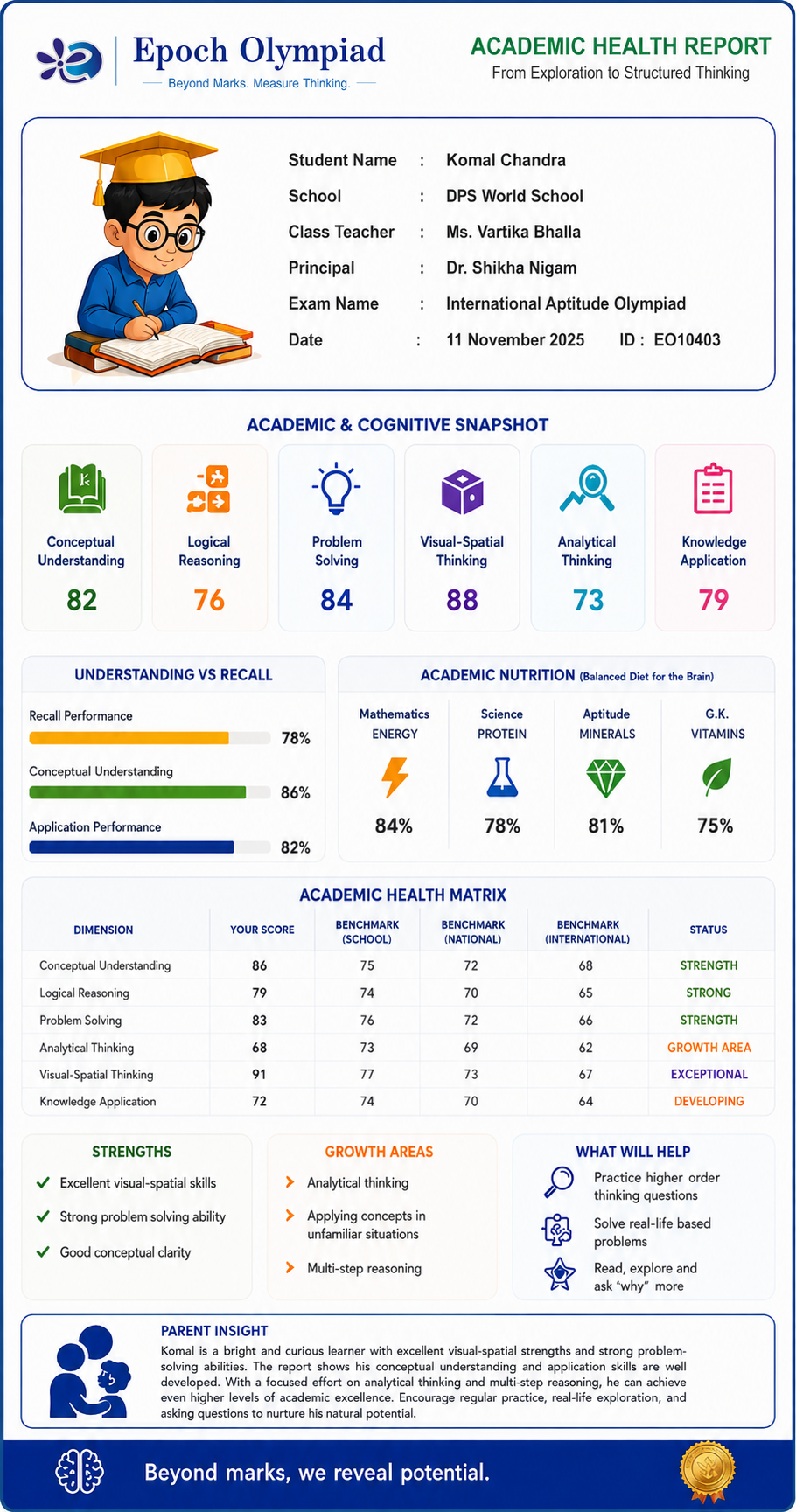
The edition that separates remembering from understanding
Once marks enter the picture they start hiding things. Two learners can score the same and be in completely different places — one recalled the answer, the other reasoned it out. This edition reports those as separate numbers, because the difference between them predicts what happens next year.
Every dimension is then placed against three cohorts: the learner's own school, the national field and the international field. A score of 68 means very little on its own; 68 against a national 69 and an international 62 means something specific.

Academic Health Report
From Exploration to Structured Thinking

- Student Name :
- Komal Chandra
- School :
- DPS World School
- Class Teacher :
- Ms. Vartika Bhalla
- Principal :
- Dr. Shikha Nigam
- Exam Name :
- International Aptitude Olympiad
- Date :
- 11 November 2025
- Report ID :
- EO10403
Academic & cognitive snapshot
Understanding vs recall
Three different questions, three different answers
What was remembered
What was genuinely understood
What could be used in a new situation
Academic nutrition
A balanced diet for the brain, subject by subject
Academic health matrix
Every dimension read against school, national and international cohorts
| Dimension | Your score | Benchmark School | Benchmark National | Benchmark International | Status |
|---|---|---|---|---|---|
| Conceptual Understanding | 0 | 0 | 0 | 0 | STRENGTH |
| Logical Reasoning | 0 | 0 | 0 | 0 | STRONG |
| Problem Solving | 0 | 0 | 0 | 0 | STRENGTH |
| Analytical Thinking | 0 | 0 | 0 | 0 | GROWTH AREA |
| Visual-Spatial Thinking | 0 | 0 | 0 | 0 | EXCEPTIONAL |
| Knowledge Application | 0 | 0 | 0 | 0 | DEVELOPING |
Conceptual Understanding
Your score
School
0
National
0
International
0
Logical Reasoning
Your score
School
0
National
0
International
0
Problem Solving
Your score
School
0
National
0
International
0
Analytical Thinking
Your score
School
0
National
0
International
0
Visual-Spatial Thinking
Your score
School
0
National
0
International
0
Knowledge Application
Your score
School
0
National
0
International
0
Strengths
- Excellent visual-spatial skills
- Strong problem solving ability
- Good conceptual clarity
Growth areas
- Analytical thinking
- Applying concepts in unfamiliar situations
- Multi-step reasoning
What will help
- Practice higher order thinking questions
- Solve real-life based problems
- Read, explore and ask “why” more
Parent insight
“Komal is a bright and curious learner with excellent visual-spatial strengths and strong problem-solving abilities. The report shows his conceptual understanding and application skills are well developed. With a focused effort on analytical thinking and multi-step reasoning, he can achieve even higher levels of academic excellence. Encourage regular practice, real-life exploration, and asking questions to nurture his natural potential.”
Beyond marks, we reveal potential.
Stage 3 — Senior Years
Epoch Olympiad Advanced
From Structured Thinking to Advanced Application
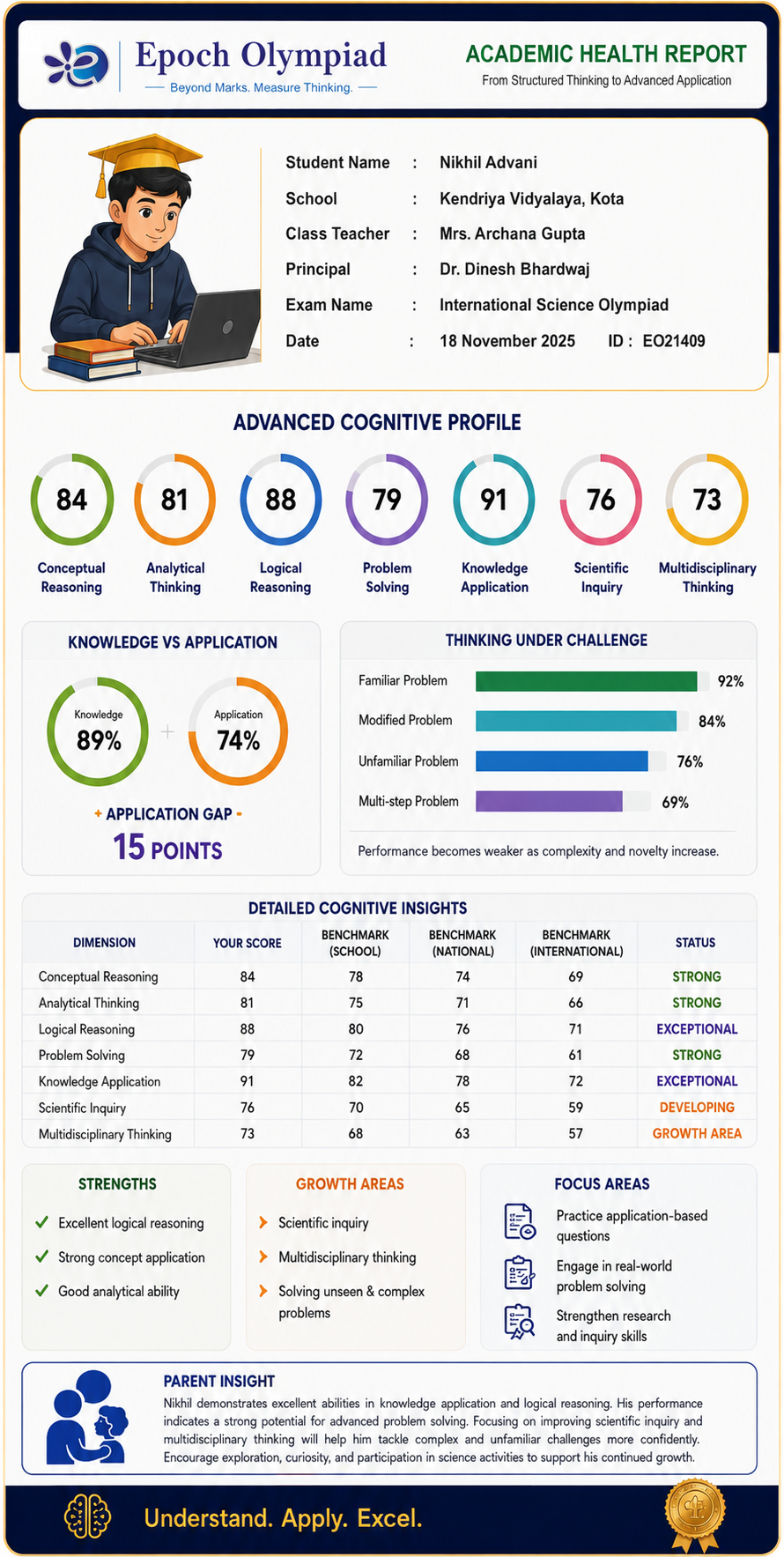
Where knowing a concept and being able to use it stop being the same thing
Senior learners rarely fail because they do not know the material. They stall the moment a question stops looking like the one they practised. This edition measures that directly: the same learner is scored on familiar, modified, unfamiliar and multi-step problems, and the slope between them is the finding.
It also states the application gap outright — knowledge at 89 percent against application at 74 leaves fifteen points that no amount of revision will close. Closing it needs different practice, and the report says which.
Academic Health Report
From Structured Thinking to Advanced Application

- Student Name :
- Nikhil Advani
- School :
- Kendriya Vidyalaya, Kota
- Class Teacher :
- Mrs. Archana Gupta
- Principal :
- Dr. Dinesh Bhardwaj
- Exam Name :
- International Science Olympiad
- Date :
- 18 November 2025
- Report ID :
- EO21409
Advanced cognitive profile
Knowledge vs application
Application gap
0 points
Thinking under challenge
The same learner, four levels of novelty
Performance weakens as complexity and novelty increase — the shape of that decline matters more than any single score above it.
Detailed cognitive insights
Seven dimensions, four reference points each
| Dimension | Your score | Benchmark School | Benchmark National | Benchmark International | Status |
|---|---|---|---|---|---|
| Conceptual Reasoning | 0 | 0 | 0 | 0 | STRONG |
| Analytical Thinking | 0 | 0 | 0 | 0 | STRONG |
| Logical Reasoning | 0 | 0 | 0 | 0 | EXCEPTIONAL |
| Problem Solving | 0 | 0 | 0 | 0 | STRONG |
| Knowledge Application | 0 | 0 | 0 | 0 | EXCEPTIONAL |
| Scientific Inquiry | 0 | 0 | 0 | 0 | DEVELOPING |
| Multidisciplinary Thinking | 0 | 0 | 0 | 0 | GROWTH AREA |
Conceptual Reasoning
Your score
School
0
National
0
International
0
Analytical Thinking
Your score
School
0
National
0
International
0
Logical Reasoning
Your score
School
0
National
0
International
0
Problem Solving
Your score
School
0
National
0
International
0
Knowledge Application
Your score
School
0
National
0
International
0
Scientific Inquiry
Your score
School
0
National
0
International
0
Multidisciplinary Thinking
Your score
School
0
National
0
International
0
Strengths
- Excellent logical reasoning
- Strong concept application
- Good analytical ability
Growth areas
- Scientific inquiry
- Multidisciplinary thinking
- Solving unseen & complex problems
Focus areas
- Practice application-based questions
- Engage in real-world problem solving
- Strengthen research and inquiry skills
Parent insight
“Nikhil demonstrates excellent abilities in knowledge application and logical reasoning. His performance indicates a strong potential for advanced problem solving. Focusing on improving scientific inquiry and multidisciplinary thinking will help him tackle complex and unfamiliar challenges more confidently. Encourage exploration, curiosity, and participation in science activities to support his continued growth.”
Understand. Apply. Excel.
Questions Parents Ask
Reading the report with confidence
A diagnostic report only helps if it is understood the way it was intended. These are the questions that come up most often.
An Academic Health Report is a diagnostic report designed to help parents and educators understand how a child learns—not just how many marks they scored. It brings together performance across relevant cognitive and academic dimensions, identifies strengths and growth areas, provides meaningful benchmarks where applicable, and suggests what may help the learner next.
A traditional report card mainly communicates academic performance. The Academic Health Report goes further by examining different dimensions of learning and thinking. Depending on the learner's stage, it may show understanding, reasoning, problem-solving, application and other relevant dimensions. It is designed for insight and growth, not simply ranking.
Children develop and learn differently at different ages. The Academic Health Report therefore has three age-tuned editions: Early Years, School Years and Senior Years. The framework remains connected, but the way learning and thinking are described becomes more advanced as the learner grows.
The dimensions depend on the learner's stage. They can include areas such as observation, pattern recognition and learning readiness in the Early Years; conceptual understanding, logical reasoning, problem-solving, visual-spatial thinking, analytical thinking and knowledge application during the School Years; and more advanced dimensions such as conceptual reasoning, scientific inquiry and multidisciplinary thinking in the Senior Years.
For editions that use scored benchmarking, a learner's performance can be read alongside relevant school, national and international cohorts. This provides context to the score instead of treating the number in isolation. The Early Years edition uses qualitative developmental descriptions rather than rank or percentile.
Strengths show abilities that are developing well. Growth areas identify abilities that are still developing and may benefit from further practice or experience. They are not labels of failure. The report connects these areas with practical suggestions that parents and educators can use.
Use it as a guide for understanding and supporting your child's learning—not as a comparison tool. Read the strengths, growth areas and recommended next steps together. Discuss the insights with the child and, where appropriate, with the teacher so that everyday learning experiences can respond to what the report reveals.
Each report provides a current-year view of the learner's strengths, growth areas and learning profile.
Individual reports are intended for the learner and family, while schools receive aggregated views of their participating cohort. The report is designed to support learning and development rather than public comparison.
See what a report says about your child
Every edition is a full diagnostic document, not a summary sheet. Ask for the sample that matches your child's stage and read it end to end.
For parents
See a full sample edition for your child's stage and understand exactly what the report will tell you before you register.
For schools
Bring the report to a whole cohort and receive aggregated views of how thinking is distributed across your classrooms.