
In this article3 sections
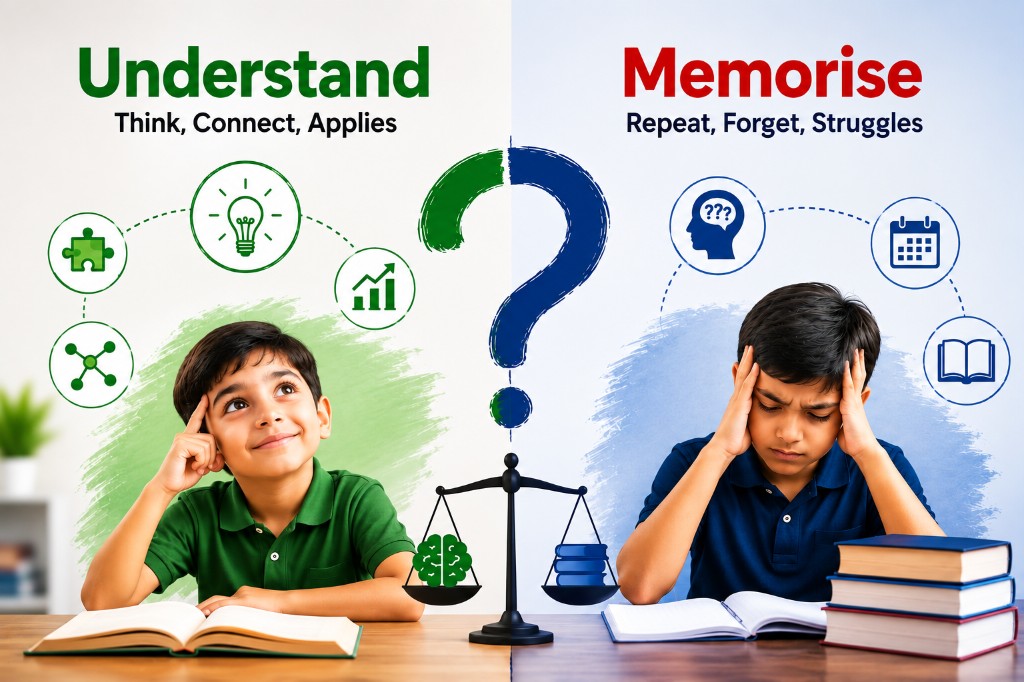
Good marks matter: they show that a child has learned and performed well in a particular assessment. But a child's potential is bigger than a number. Education should help children think, question, reason, solve problems, communicate, adapt, make decisions and keep learning.
What does holistic education mean?
Holistic education does not mean ignoring academics. It means recognising that academic knowledge is one important part of development—not the entire picture. Knowledge gives children a foundation, thinking skills help them use it, experiences help them apply it and feedback helps them grow.
Six dimensions of a more complete learning journey
- 1
Understanding
Understand ideas rather than simply remember answers.
- 2
Thinking
Question, compare, connect and reason.
- 3
Application
Use knowledge in unfamiliar situations.
- 4
Problem-solving
Approach challenges and explore possible solutions.
- 5
Curiosity
Remain willing to ask, explore and discover.
- 6
Growth
Recognise strengths and areas for improvement.
Holistic does not mean everything at once
It does not mean more subjects, homework or examinations. It means a better balance between knowing, understanding, thinking, applying and growing.
How the Epoch ecosystem supports holistic learning
Brainiac Global builds the thinking foundation for early learners. Epoch Olympiad assesses, challenges and explores subject learning for Classes 1–10. IHOST brings Mathematics, Science, Aptitude and General Knowledge together, while IFLY supports finance and digital literacy. MY CCBee makes daily learning visible, and the Academic Health Report helps families see beyond one score.
“Beyond marks. Beyond memorisation. Towards the whole child.”
Questions parents ask
Does holistic education mean academics are not important?
No. Academic knowledge remains an important foundation; holistic education complements it with thinking, application and growth.
Why are scores not enough?
Scores show performance in an assessment but may not reveal reasoning, application, curiosity or how a child approaches unfamiliar problems.
How can parents support holistic development?
Encourage questions, conversations, problem-solving, exploration, reading, independent thinking and reflection.
For schools
See what an Academic Health Report reveals about your cohort.
Register your school to receive dimension-level insights for every learner, benchmarked at school, national and international level.
Register your school