In this article3 sections
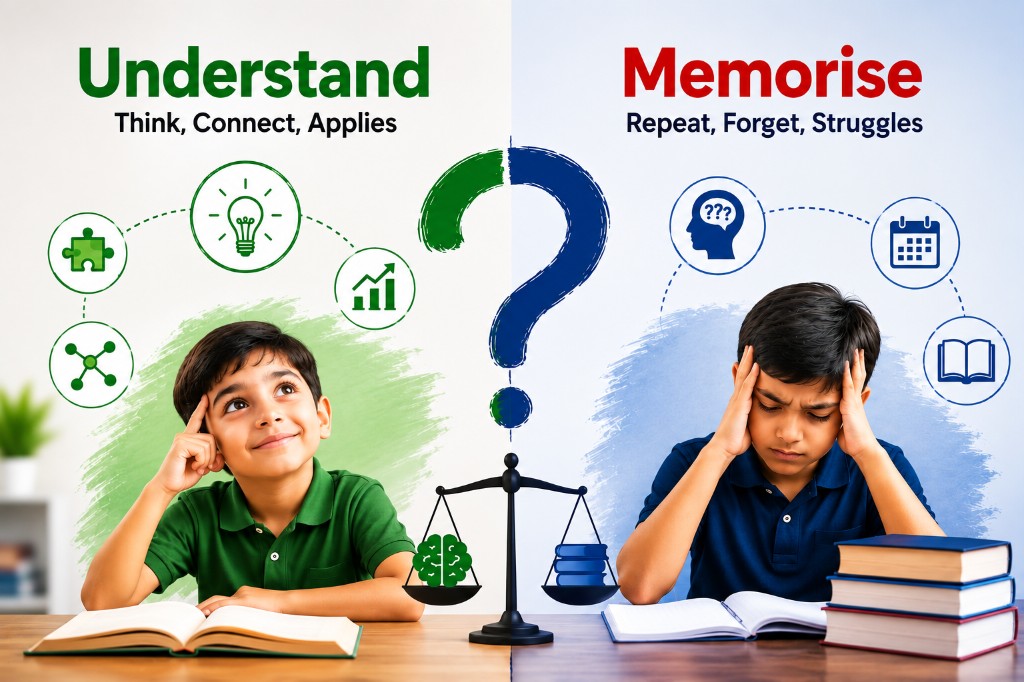
A child can remember an answer without truly understanding the idea behind it. They may score well on familiar questions but become confused when the question changes. This does not mean the child is weak—it raises an important question: is your child learning to remember, or learning to understand?
Five signs of understanding
- 1
Can your child explain the answer?
Ask why it is correct. Understanding usually appears as reasoning in the child's own words.
- 2
Can your child use the idea in a new situation?
Change the question slightly. Real learning becomes useful when the situation changes.
- 3
Does your child ask why and how?
Questions show that the child is trying to connect ideas rather than collect answers.
- 4
Can your child spot a mistake?
Identifying an error and explaining why it is wrong is a foundation for independent reasoning.
- 5
Does learning stay after the question changes?
Understanding is flexible when wording, examples or combinations change.
Understanding is more than marks
- Conceptual understanding
- Reasoning
- Application
- Problem-solving
- Observation
- Decision-making
The simple parent test
The next time your child gives you the correct answer, don't stop at “Correct!” Try asking: “How did you get this answer?” That one question can tell you much more about learning than the answer alone.
“Don't just ask what your child knows. Ask how your child thinks.”
For schools
See what an Academic Health Report reveals about your cohort.
Register your school to receive dimension-level insights for every learner, benchmarked at school, national and international level.
Register your school