
In this article4 sections
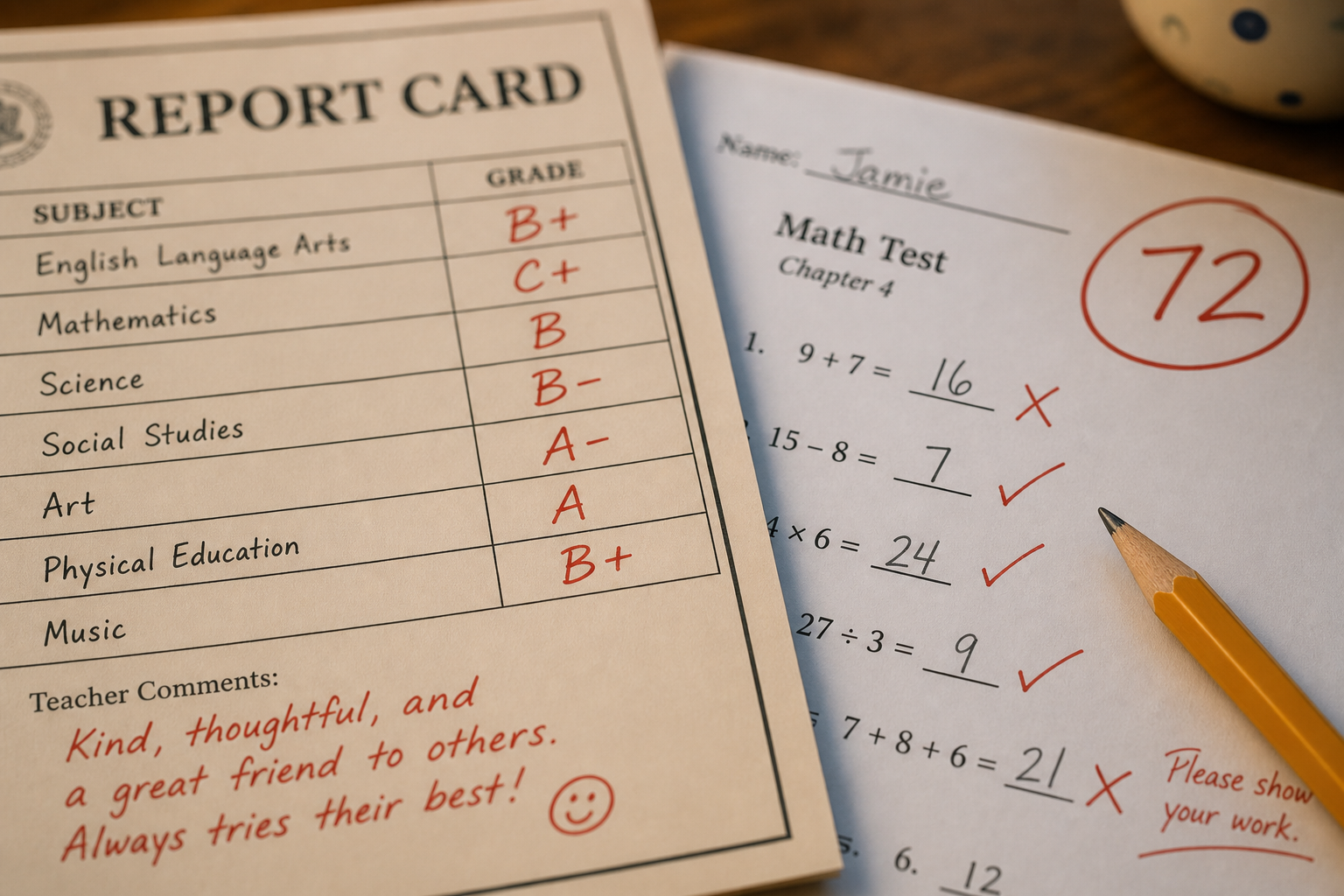
Two children sit the same paper and both score 88. One arrived there by recalling a method she had practised forty times. The other met a question she had never seen before and reasoned her way to the answer. The mark sheet records them as identical learners. They are not.
In short
- Academic intelligence describes what a learner has acquired; cognitive intelligence describes how a learner processes.
- Marks measure the first well and the second barely at all.
- The gap between the two is where most unexplained underperformance hides.
- Both can be measured — but only if the assessment is designed to separate them.
Two different questions
Academic intelligence answers the question what does this child know? It is built from syllabus, instruction and practice, and it is properly measured by an examination. When a school reports that a learner is strong in mathematics, this is almost always what is meant.
Cognitive intelligence answers a different question: how does this child arrive at an answer? It covers reasoning, pattern recognition, memory, attention, analytical thinking and the willingness to attempt an unfamiliar problem. It is comparatively stable, it develops with the right stimulation, and it is largely invisible on a conventional mark sheet.
The same learner, seen two ways
| Academic intelligence | Cognitive intelligence | |
|---|---|---|
| The question it answers | What has been learnt? | How is thinking done? |
| Built from | Syllabus, teaching, practice | Reasoning habits, exposure, development |
| Moves | Term to term, with revision | Slowly, with sustained stimulation |
| Measured by | Examinations on taught content | Unfamiliar problems with no rehearsed method |
| Fails when | Content was not covered | The question does not resemble the practice |
The question it answers
Academic intelligence
What has been learnt?
Cognitive intelligence
How is thinking done?
Built from
Academic intelligence
Syllabus, teaching, practice
Cognitive intelligence
Reasoning habits, exposure, development
Moves
Academic intelligence
Term to term, with revision
Cognitive intelligence
Slowly, with sustained stimulation
Measured by
Academic intelligence
Examinations on taught content
Cognitive intelligence
Unfamiliar problems with no rehearsed method
Fails when
Academic intelligence
Content was not covered
Cognitive intelligence
The question does not resemble the practice
“A rehearsed answer and a reasoned answer look the same on paper. Only one of them survives an unfamiliar question.”
Why the distinction matters in a real classroom
Consider the learner every teacher recognises: attentive, diligent, consistently around 80%, and yet visibly lost the moment a question is phrased in an unfamiliar way. Nothing in her report card explains this. Her marks are good, so no intervention is triggered, and the difficulty is quietly re-labelled as carelessness or exam pressure.
Now consider her opposite: a learner who reasons quickly and enjoys puzzles, but whose marks sit at 60% because he never consolidated the basics of a topic taught two years ago. He is often described as bright but lazy. Neither description is diagnostic, and neither tells a teacher what to do on Monday morning.
An illustrative profile
Strong grasp of taught material
Applies method reliably when the format is familiar
Struggles once no rehearsed route exists
Abandons unfamiliar problems early
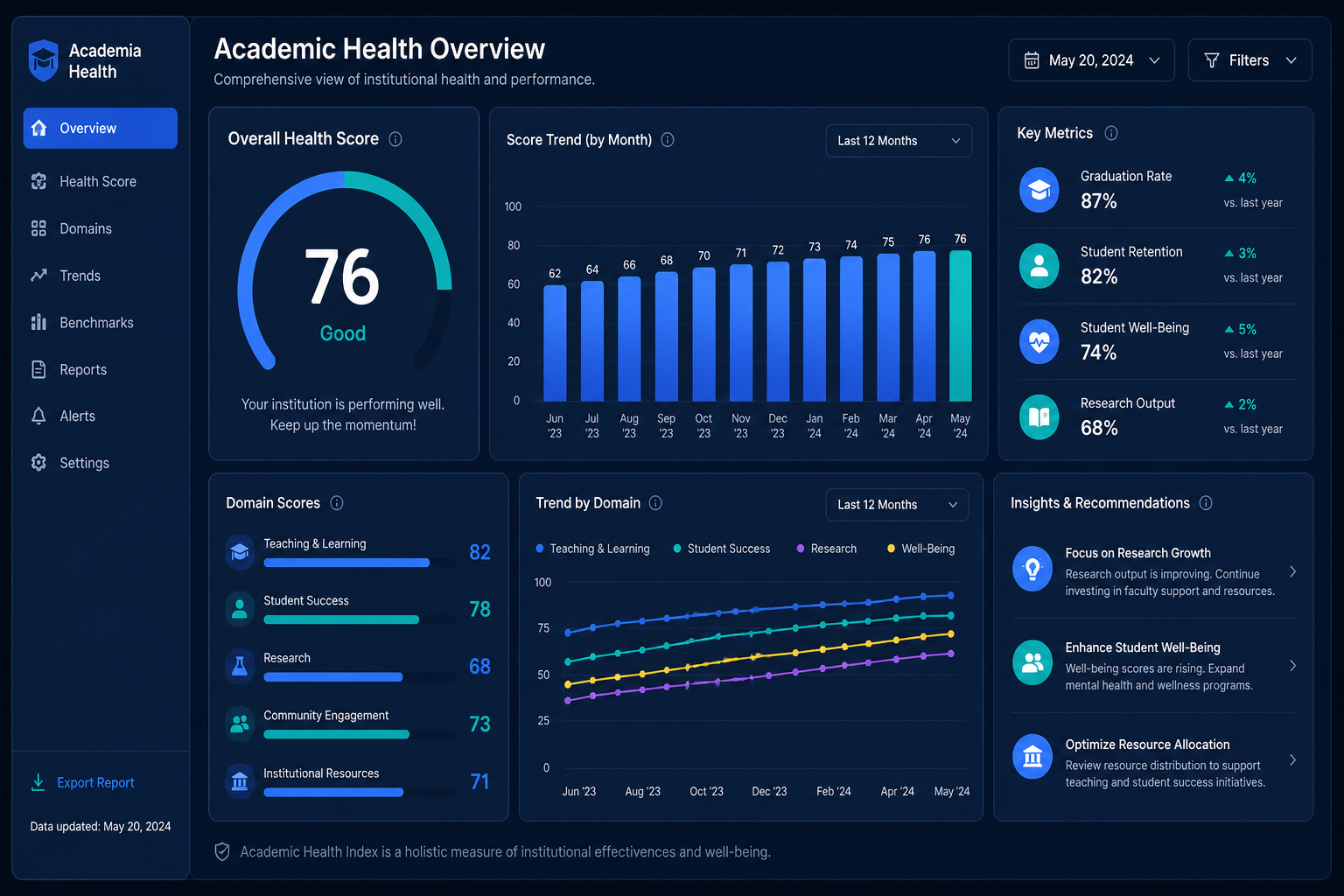
A sample learner profile from an Academic Health Report, shown to demonstrate the shape of the data — not aggregate research findings.
Read as a single mark, this learner is a 70% student. Read as a profile, she is something far more specific: a learner whose acquisition is ahead of her reasoning. That is a teachable problem with a known remedy — and it is completely invisible until the two things are measured apart.
What it takes to measure the difference
An assessment can only separate acquisition from reasoning if it is built to. That means questions a learner cannot have rehearsed, scoring that records the dimension being tested rather than only the total, and reporting that resolves into parts instead of collapsing into one number.
How our assessments approach it
- 1
Map the dimension, not just the topic
Every question is tagged to the cognitive dimension it draws on, so the score can later be read by dimension rather than only by subject.
- 2
Include the unrehearsed
A portion of each paper presents problems in forms the learner has not practised, which is the only reliable way to observe reasoning rather than recall.
- 3
Keep it age-appropriate
What counts as evidence of reasoning at Kindergarten is not what counts at Class 9, so the instrument changes with the developmental stage.
- 4
Report the parts
Results are returned as a profile across dimensions with school, national and international benchmarks, so a strength and a gap can be seen side by side.
Our framework at a glance
Multiple
cognitive dimensions, assessed age-appropriately
KG–10
Stages covered, age-appropriately
3
Benchmark levels: school, national, global

One caution
Cognitive profiling is diagnostic, not a label. A low score on a dimension describes where a learner is today under one set of conditions — it is a starting point for teaching, never a ceiling on a child.
What a school can do with this
Practical next steps
- Read cohort results by dimension, not only by subject average.
- Look for learners whose acquisition and reasoning scores diverge sharply in either direction.
- Give reasoning its own place on the timetable rather than leaving it to incidental practice.
- Re-measure after two terms — reasoning moves slowly, so short cycles will mislead you.
- Share the profile, not the rank, with parents.
Questions we are asked
Is cognitive intelligence fixed?
No. It is more stable than acquired knowledge, which is exactly why it is diagnostically useful, but it develops with sustained stimulation. That development is slow enough that it should be measured over years, not weeks.
Does this replace examinations?
Not at all. Examinations measure acquisition well, and acquisition matters. The argument here is that a school which measures only acquisition is working with half the picture.
Can this be assessed at Kindergarten?
Yes. At Kindergarten level, assessment should be age-appropriate and child-friendly. The International Brain Booster Olympiad uses picture-based, paper-and-crayon activities designed to observe foundational thinking abilities.
What does a school receive?
An Academic Health Report for each learner — a profile across the cognitive and academic dimensions with benchmarks and identified growth areas — plus aggregated cohort insights for the school.
For schools
See what an Academic Health Report reveals about your cohort.
Register your school to receive dimension-level insights for every learner, benchmarked at school, national and international level.
Register your school